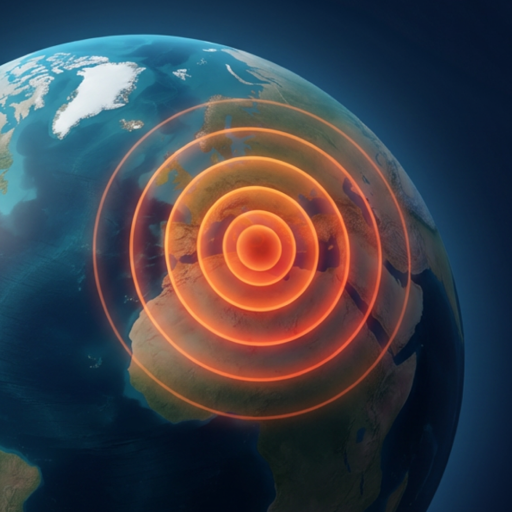
How Earthquakes Happen: Tectonic Plates Explained
Learn how tectonic plates cause earthquakes, the types of faults, what happens from stress to rupture, and why some regions experience more earthquakes than others.
Tectonic Plates: Earth's Moving Puzzle Pieces
Earth's outer shell — the lithosphere — is divided into about 15–20 major tectonic plates and many smaller ones. These plates float on the semi-molten asthenosphere and move continuously, driven by heat convection in Earth's mantle. The plates move at rates of 1–10 cm per year — roughly the rate your fingernails grow.
Where plates meet, enormous forces build up over decades or centuries. When the accumulated stress exceeds the strength of the rock, sudden rupture occurs — releasing energy as seismic waves. This is an earthquake.
Types of Plate Boundaries and Faults
- Convergent boundaries (subduction zones): One plate dives beneath another. Generates the largest earthquakes on Earth — including the 1960 M9.5 Chile and 2011 M9.0 Japan events. Countries: Japan, Chile, Indonesia.
- Transform boundaries (strike-slip faults): Plates slide horizontally past each other. Famous example: San Andreas Fault in California and the North Anatolian Fault in Turkey.
- Divergent boundaries: Plates pull apart. Less common for large earthquakes. Mid-ocean ridges are typical examples.
- Intraplate earthquakes: Occur within a plate, far from boundaries. Less common but can be destructive when they strike stable continental crust with old fault systems.
From Stress to Rupture: The Earthquake Cycle
The seismic cycle describes the repeating pattern of stress accumulation and release along a fault. During the interseismic period, tectonic stress builds gradually. When it exceeds the fault's frictional resistance, a co-seismic rupture occurs — the earthquake. The rupture propagates along the fault at 2–3 km/s, radiating seismic waves outward in all directions.
After the mainshock, aftershocks continue as the surrounding crust adjusts to the new stress state. A major earthquake may produce thousands of aftershocks over months or years.
The Most Seismically Active Regions
The Ring of Fire accounts for roughly 90% of all earthquakes worldwide. It encircles the Pacific Ocean through Chile, Peru, Mexico, California, Alaska, Japan, the Philippines, and New Zealand. The remainder occur along the Alpide Belt — from Portugal through the Mediterranean, Turkey, Iran, and into Asia.
Track seismic activity across all these regions in real time with the Earthquake Globe live map. Set custom push alerts for the regions that matter to you.
Related Reading
Frequently Asked Questions
- What causes most earthquakes?
- Most earthquakes (90%+) are caused by tectonic plate interactions — either at subduction zones (where one plate dives under another), transform boundaries (plates sliding past each other), or divergent boundaries (plates pulling apart). Human activity (fracking, reservoir-induced seismicity) causes the remaining small percentage.
- What is a fault line?
- A fault is a fracture or zone of fractures in Earth's crust where rock on either side has moved relative to the other. Fault lines are the surface traces of these fractures. Active faults are those that have moved in the past ~10,000 years and are likely to move again.
- Why do aftershocks happen after a large earthquake?
- Aftershocks occur because the main rupture redistributes stress in the surrounding crust. The new stress distribution triggers additional smaller ruptures on nearby fault segments or the same fault. The Omori Law describes how aftershock frequency decreases with time after the mainshock.
- What are the deepest earthquakes?
- Deep-focus earthquakes occur at depths of 300–700 km, mostly in subducting oceanic plates. The 2013 Okhotsk Sea earthquake (M8.3) at 609 km depth is among the deepest major earthquakes on record. Deep earthquakes feel different from shallow ones — they affect a larger area but with less intense local shaking.
See Tectonic Activity in Real Time
Every earthquake on a live 3D globe. Free iPhone app.
Download Free on App Store